Lesson 2 of 19 · ~8 min
Read a brief — severity & signals
You'll learn: Decode the severity scale, understand what each of the 4 pillars covers, and drill into a signal tile.
Run at least one scan from Lesson 1 so you have a real brief to look at.
01The severity scale
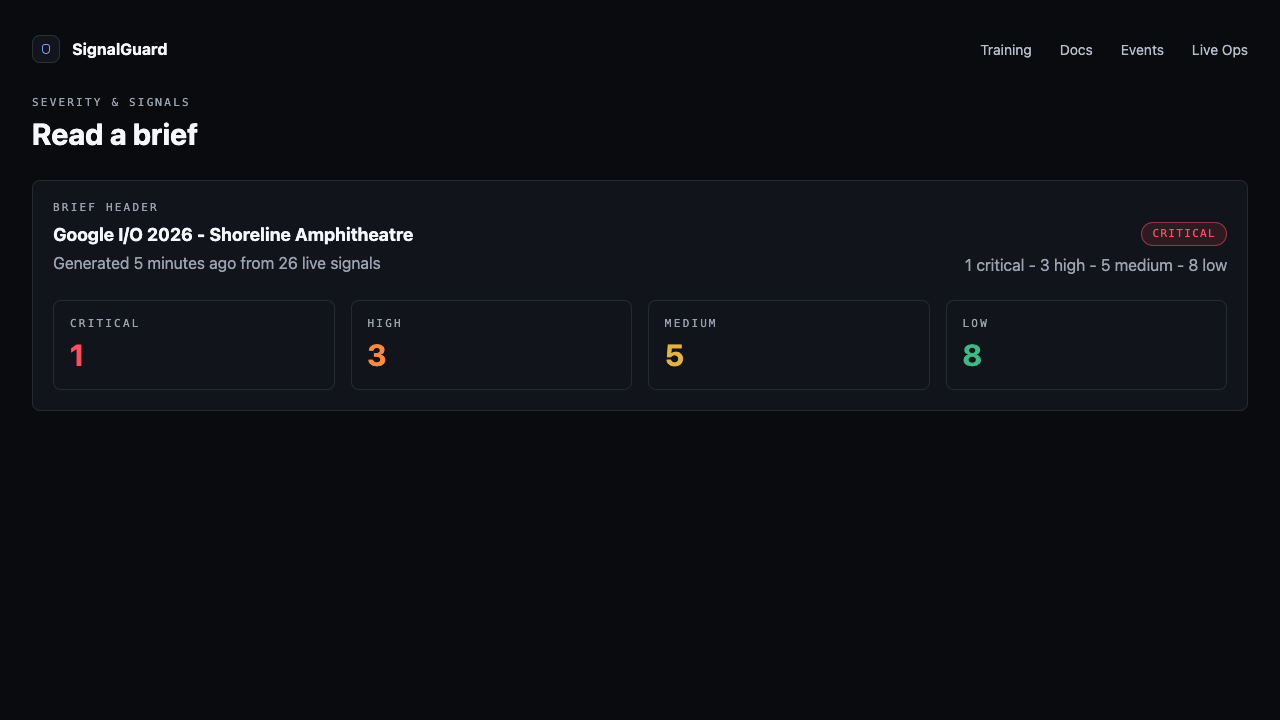
Every scan and every signal carries one of five severity levels:
- Critical — credible imminent threat. Treat as a paging-level event.
- High — elevated activity that warrants operator attention now.
- Medium — noticeable signal, worth a periodic glance.
- Low — background baseline. Nothing actionable.
- Clear / Unknown — no signal returned, or feed was unavailable.
The overall severity pill on a brief is the worst single signal severity, not an average. One critical Telegram thread elevates an otherwise quiet brief to Critical.
02The four signal pillars
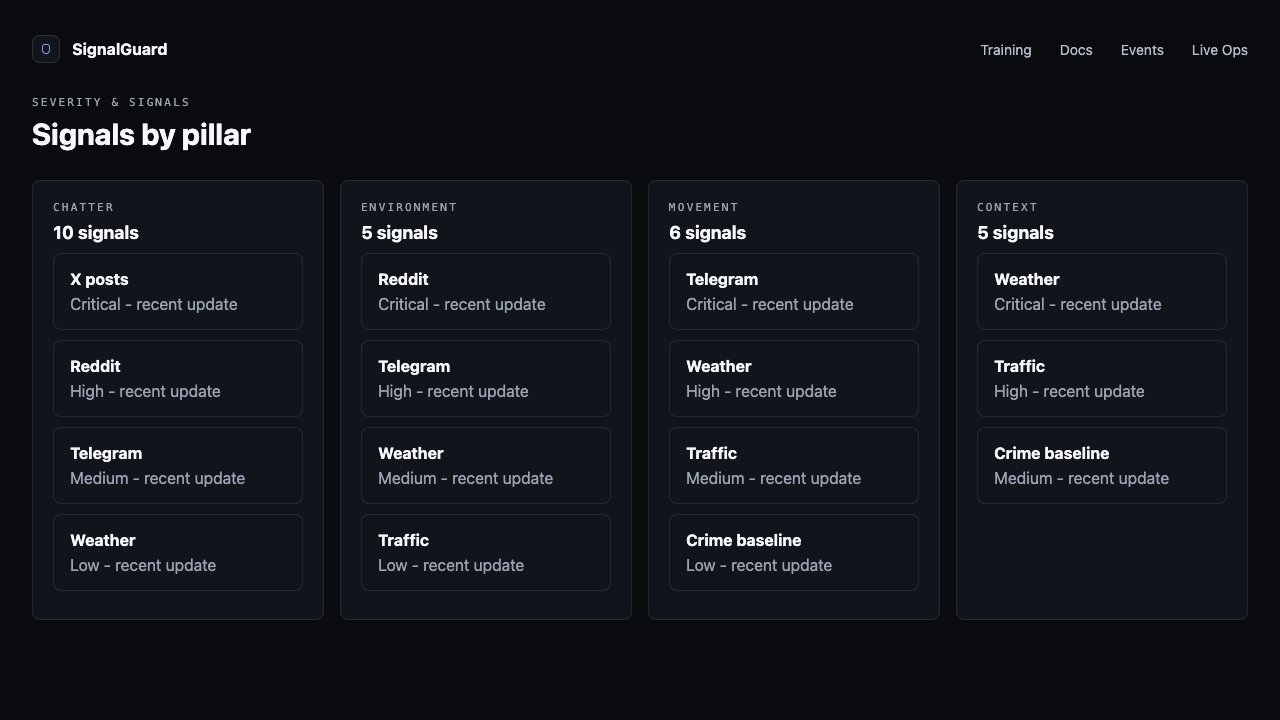
SignalGuard's 70+ signals are grouped into four pillars by what they measure:
What people are saying — X, Reddit, Bluesky, Mastodon, YouTube, Telegram, TikTok, news, dark web.
Physical hazards — weather, air quality, severe storms, wildfires, earthquakes.
Ground + air — traffic incidents, ADS-B aircraft, TFRs, FAA NOTAMs, police scanners, cellular density.
Standing posture — NTAS advisory, FBI crime baseline, FEMA disasters, Ticketmaster activity, nearby POI density.
03Drill into a signal tile
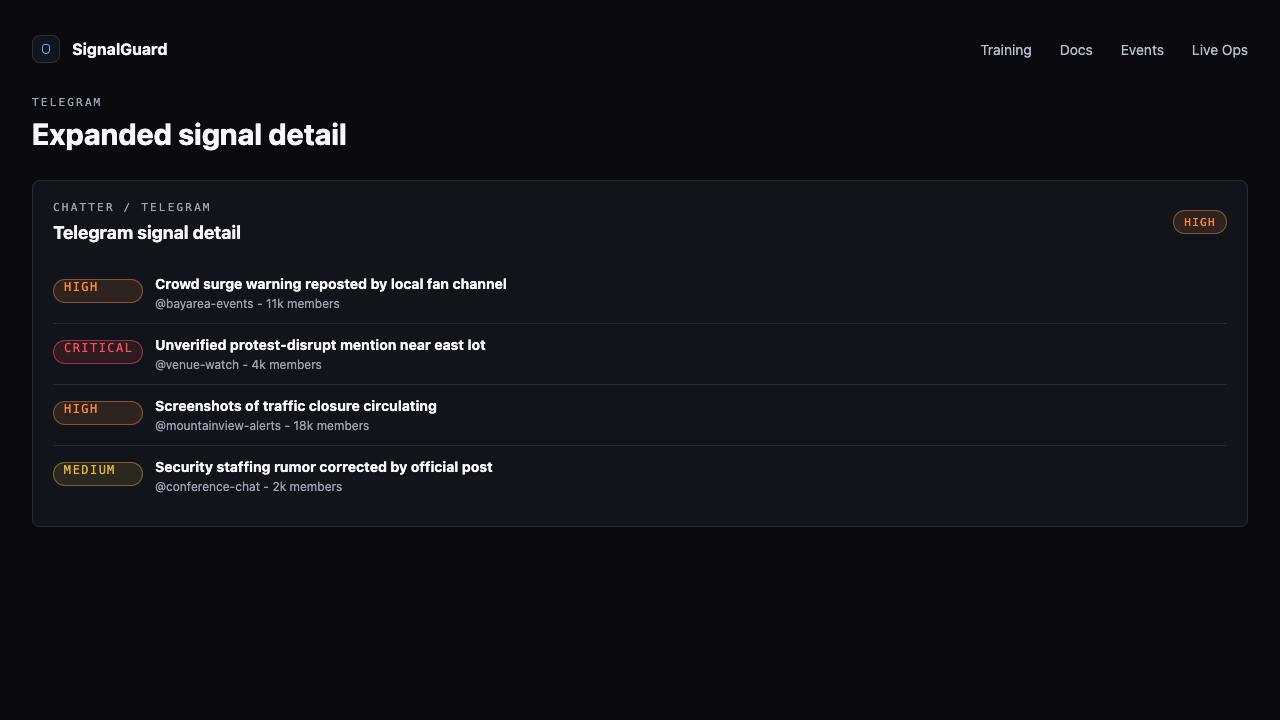
Click any signal tile to expand its full detail card. Chatter tiles open the top posts with text, author, source, and engagement metrics. Environment tiles show forecast detail, alert text, magnitude/distance. Movement tiles list incidents with coordinates. Context tiles show the underlying advisory or baseline data.
04Use citations to verify
The AI synthesis and actions include bracketed citations like [signal:weather] or [brief:synthesis]. Every claim is grounded — if a citation references a signal, that signal's card carries the source data. Don't trust an action that lacks a citation.
![An action item with [signal:traffic] highlighted, with an arrow pointing down to the Traffic signal card.](/training/img/brief-citations.png)
Tips
- Old data is stamped — every signal card shows when it was fetched. A "2h ago" weather signal during a fast-moving storm is stale; rescan.
- A "no data" tile usually means the feed was unavailable or the venue is outside its coverage area (e.g. NTAS is US-only). Not a bug.
- Bookmark the brief URL — it's permanent.
/report?scanId=<uuid>regenerates the same view from persisted data without re-running the scan.